June is National Milk Month!

I wanted to use this opportunity to highlight some amazing benefits of having some delightful dairy.
First, I will go there, let’s define what milk is.
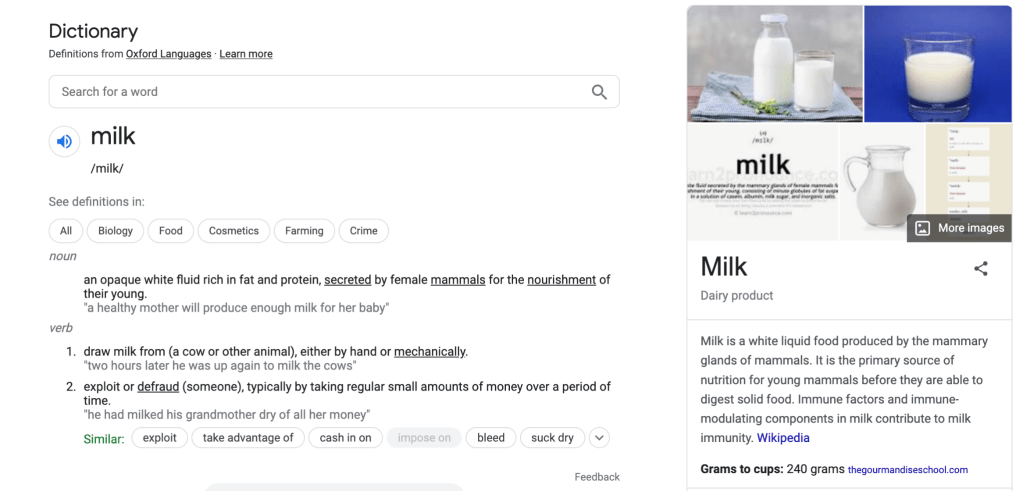
From Oxford Languages, milk is an opaque white fluid rich in fat and protein, secreted by female mammals for the nourishment of their young. Maybe that settles it, maybe it doesn’t. Feel free to tell me what you think defines what milk is in the comments.
Clearly, we can see here that even if we agree on the definition of what milk is. It says that it is for the nourishment of the young. So can we as humans have cow’s milk as part of our diets since it is for baby cows? Cow’s milk is obviously perfect for baby cows to consume, however, it’s also been found to be super beneficial for human consumption as well!
Lactose Intolerance
But what about lactose intolerance?! Doesn’t that prove that humans should not have it?
Let’s look at these meta-analyses on the topic.
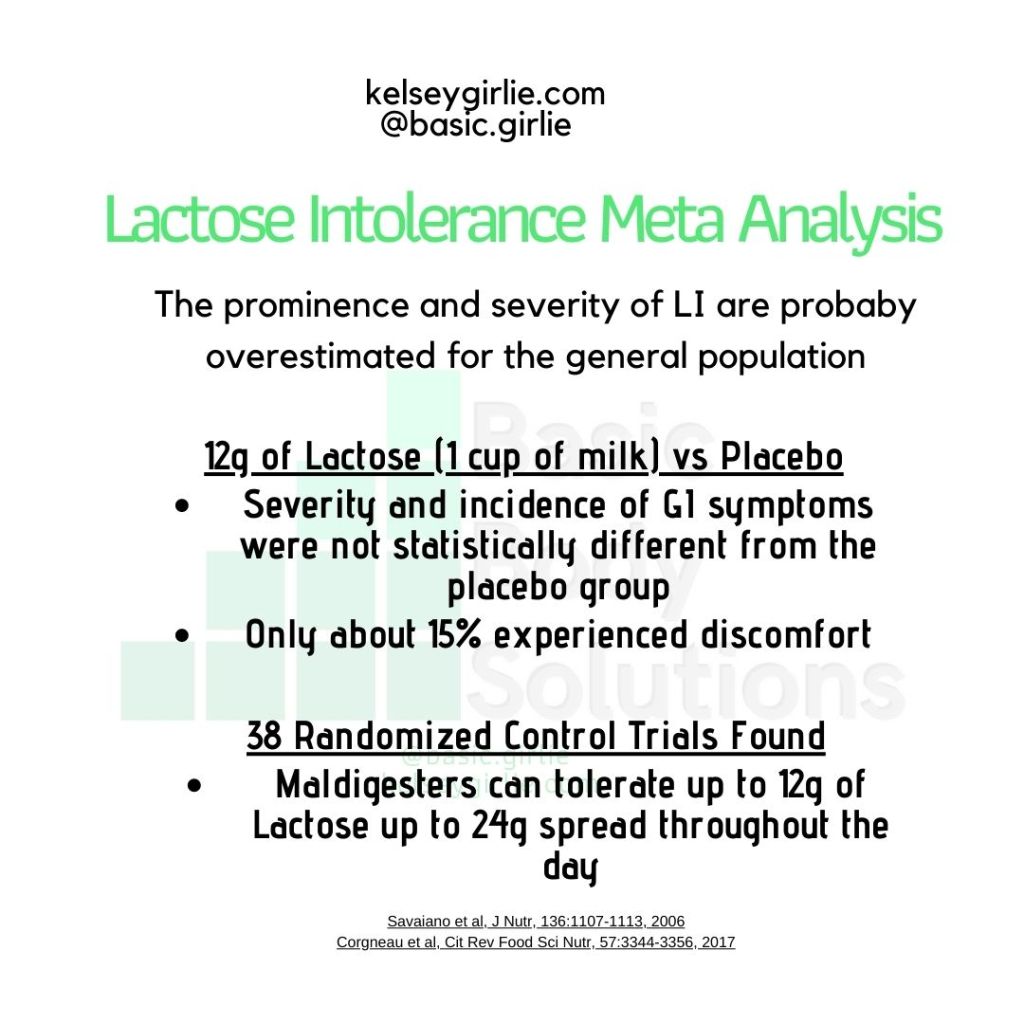
- Savaiano et al, J Nutr, 136:1107-1113, 2006
- Gave participants up to 12g of lactose (or a cup of milk) or a placebo
- The severity and incidence of GI symptoms were not statistically different from the placebo group
- About 15 people out of 100 experienced loose stools/GI discomfort
- Corgneau et al, Cit Rev Food Sci Nutr, 57:3344-3356, 2017
- 38 RCTs of those diagnosed with Lactose Intolerance
- Can tolerate up to 12g with little or no symptoms
- Up to 24g spread throughout the day for some
- The prominence and severity of LI are probably overestimated for the general population
What can we learn from these? Perhaps, if a Lactose Intolerance diagnosis has been keeping you from consuming all dairy products, you might still be able to enjoy some throughout the day, and may be worth testing especially if you enjoy having some dairy products. Keep an eye on the portion sizes though!
There is also a good deal of products that are lactose-free due to the filtration process such as the Fairlife Brand and whey isolate protein powders.

Dairy and Cancer Mortality
Overall meta-analysis of cancer risk in milk drinkers shows that there could be some cancer-reducing attributes.
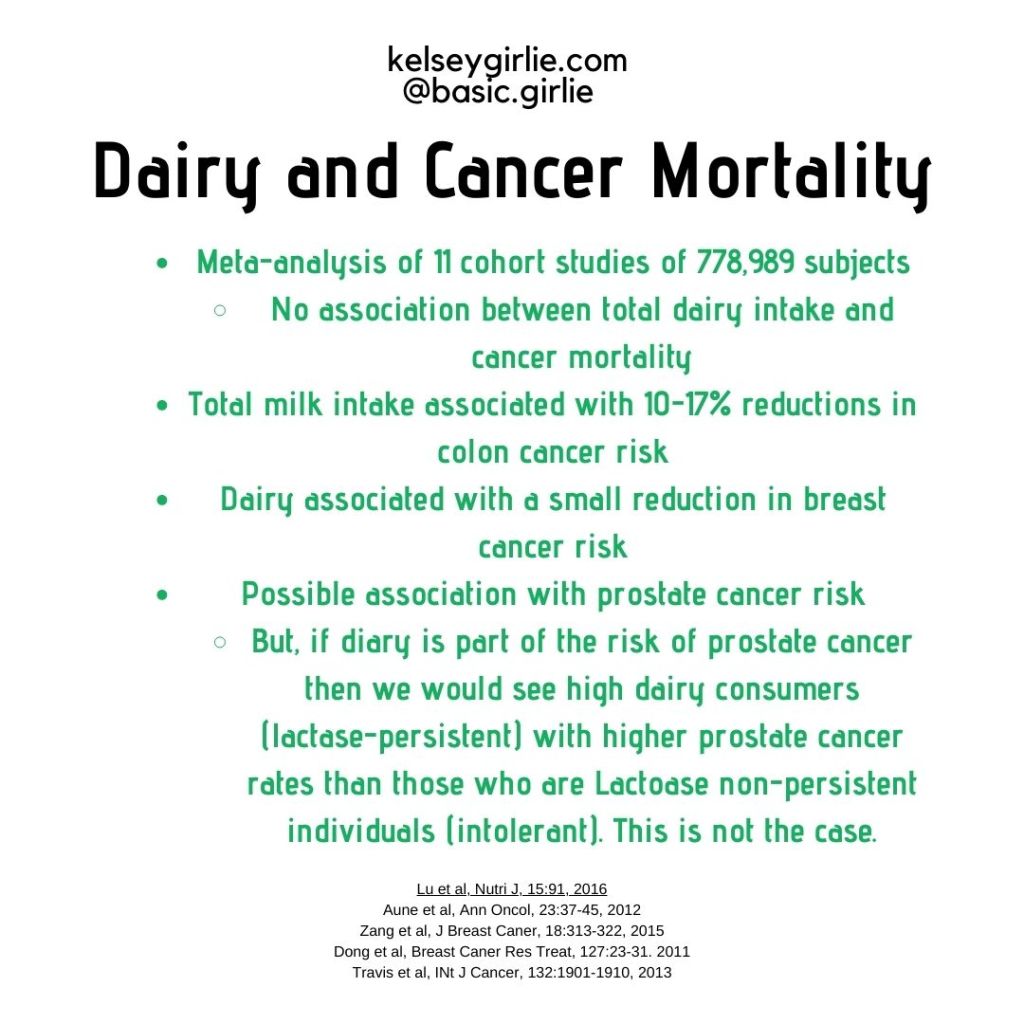
- Lu et al, Nutri J, 15:91, 2016
- Meta-analysis of 11 cohort studies of 778,989 subjects
- No association between total dairy intake and cancer mortality
- Aune et al, Ann Oncol, 23:37-45, 2012
- Meta-analysis of 19 cohort studies
- Total milk intake associated with 10-17% reductions in colon cancer risk
- Possible Association with Prostate Cancer Risk
- Most likely due to an increase in IGF-1 circulating with has been associated with prostate cancer risk
- But, if dairy is part of the risk of prostate cancer then we would see high dairy consumers (lactase-persistent) with higher prostate cancer rates than those who are Lactoase non-persistent individuals (intolerant)
- This is not the case due as found in Travis et al, INt J Cancer, 132:1901-1910, 2013
- Zang et al, J Breast Caner, 18:313-322, 2015
- Meta-analysis of 22 cohort studies and 5 case-control studies
- Dairy associated with a small reduction in breast cancer risk
- Dong et al, Breast Cancer Res Treat, 127:23-31. 2011
- Meta-analysis of 18 cohort studies
- Dairy associated with a reduction in breast cancer risk

Dairy and Cardiovascular Disease
- Guo et al, Eur J Epidemiol, 2017
- Meta-analysis of 29 cohort studies
- NO association between total dairy or milk with mortality, CHD, or CVD
Dairy and Hormones
Milk does contain natural levels of steroid hormones, like estrogens. However, the bioavailability of orally consumed estrogen is very low, like less than 5% of what is consumed, and then only a fraction of THAT would be bio-effective (active in the body)
Only 0.2% of estrogen levels would be available and free to act as hormones. (Kul, H. Climacterie 8 Suppl 1:3-63, 2005; Goyon et al, Food Addit Contam Fart A Chem Anal Control Expo Risk Assess, 33:804-816, 2016)

- Zhang et al, Wei Shen Yan Jui. 43-754-758fd, 2014
- Grgurevic et al, J Dairy Sci, 99:6005-6013, 2016
- No impact of 33 or 55g of milk powder per day on the menstrual cycle or estradiol/pregnanediol concentrations in urine for women
- NO impact of pregnant cows ilk on plasma estrone or estradiol levels, testosterone levels, or weight of reproductive organs in mice
- No effect with 10 ng/mL of estrone and estradiol was added to milk
- The adverse effect observed with 100 ng/mL was added (1000 times the physiological concentration in milk
- Humans do not have any receptors for rBGH (bovine growth hormone)
- IGF-1 concentrations are slightly higher for milk in cows treated with rBGH
- Drinking 1.5 L of milk would be equivalent to about 0.09% of the total IGF-1 produced by adults each day
Dairy and Inflammation
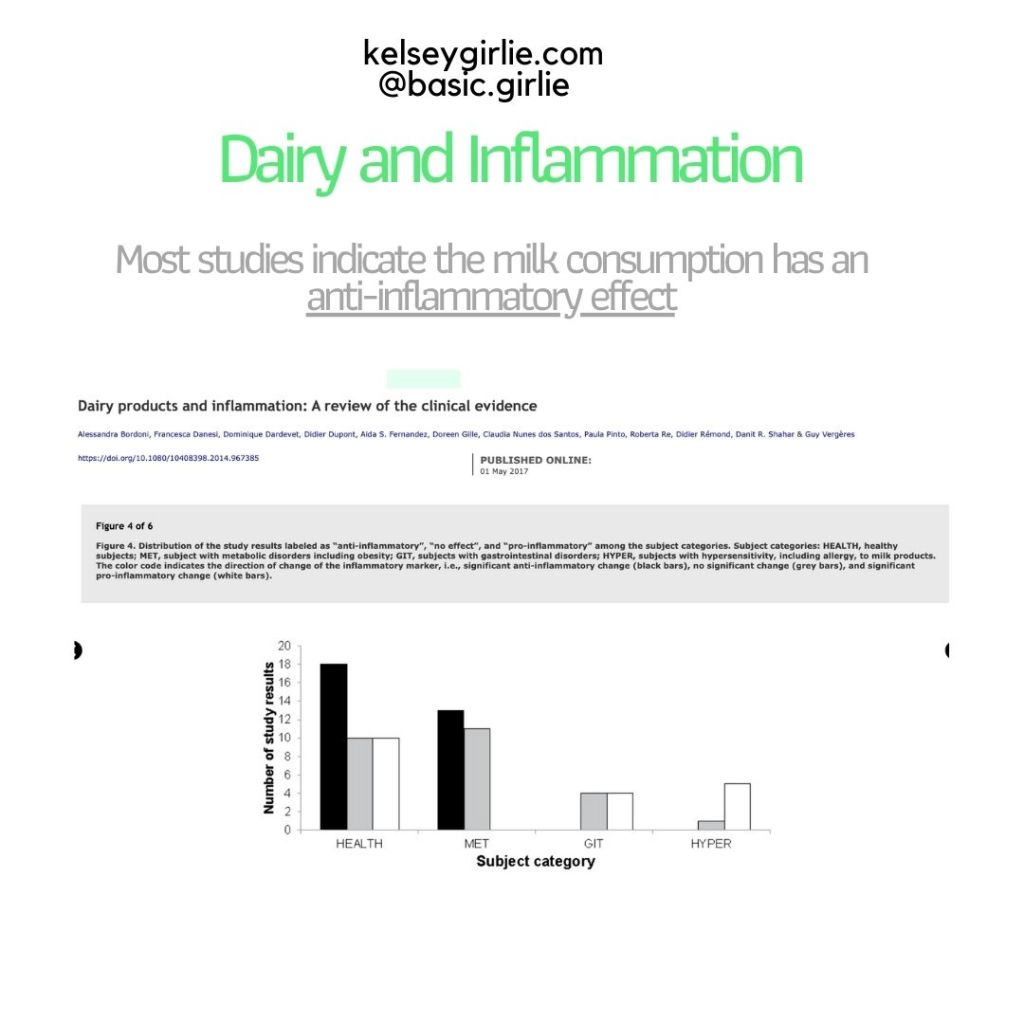
Most studies indicate that milk consumption has an anti-inflammatory effect
Bordoni et al, Crit Rev Food Sci Nutr, 57:2497-2525, 2017
Labonte et al, Ant J Clin Nutr, 97:706-717, 2013

Dairy and Weight Loss
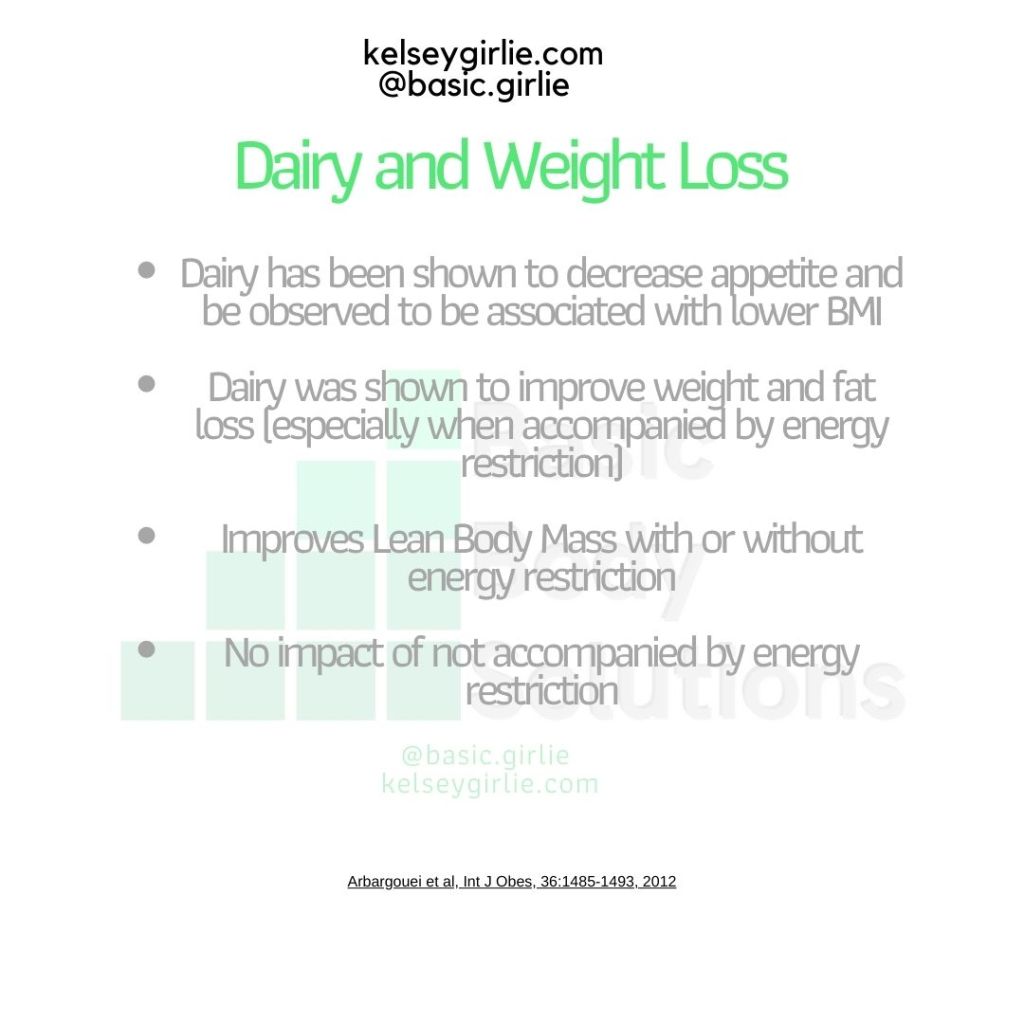
Dairy has been shown to decrease appetite and be observed to be associated with lower BMI
- Arbargouei et al, Int J Obes, 36:1485-1493, 2012
- Dairy was shown to improve weight and fat loss (especially when accompanied by energy restriction)
- Improves Lean Body Mass with or without energy restriction
- No impact of not accompanied by energy restriction

So why do people swear by eliminating dairy from diets for weight loss?
- Foods also cut out when eliminating dairy
- Cheese
- Butter
- Cream
- Ice cream
- dairy-based desserts
- Sugar-sweetened, high-calorie yogurts
- Also leads to a reduction in overall calorie intake from eliminating these energy-dense, highly palatable foods
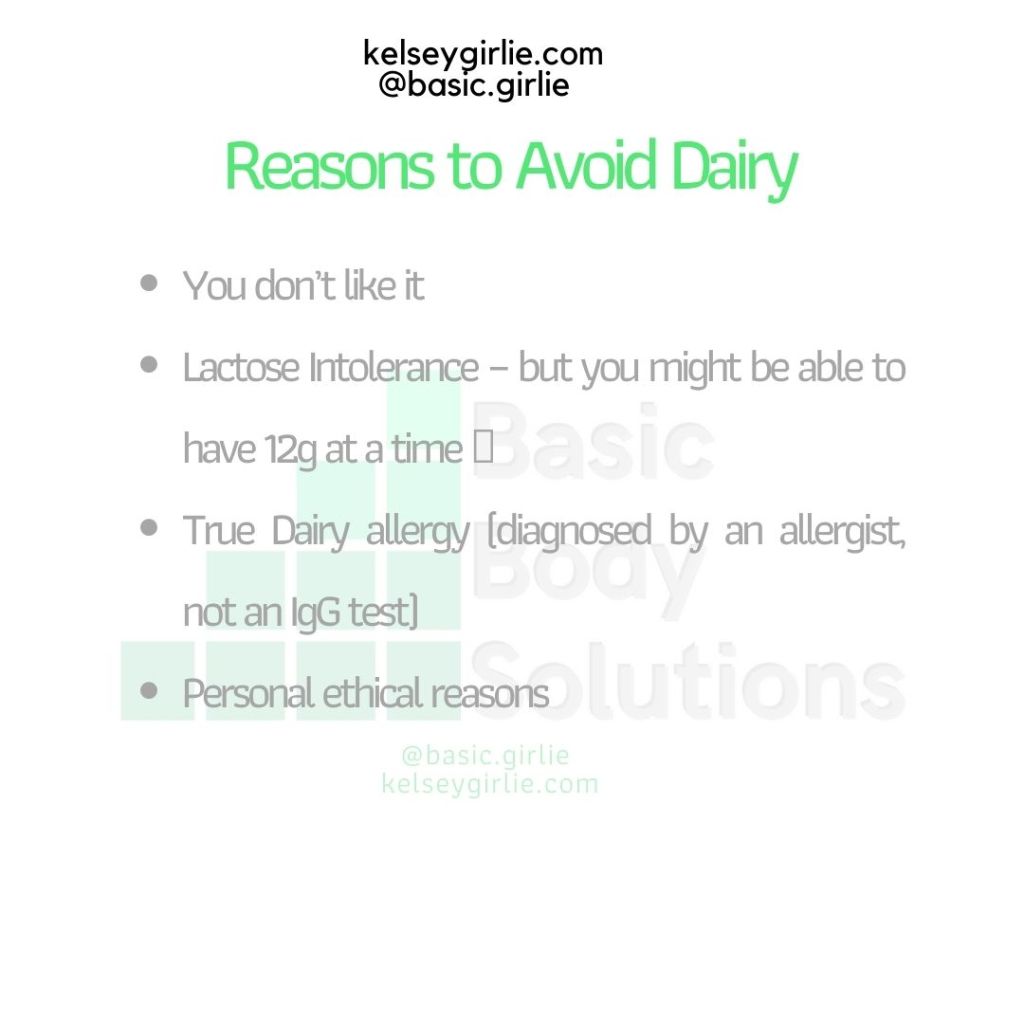
Reasons to Avoid Dairy
- You don’t like it
- Lactose Intolerance – but you might be able to have 12g at a time 🙂
- True Dairy allergy (diagnosed by an allergist, not an IgG test)
- Personal Reasons with ethics

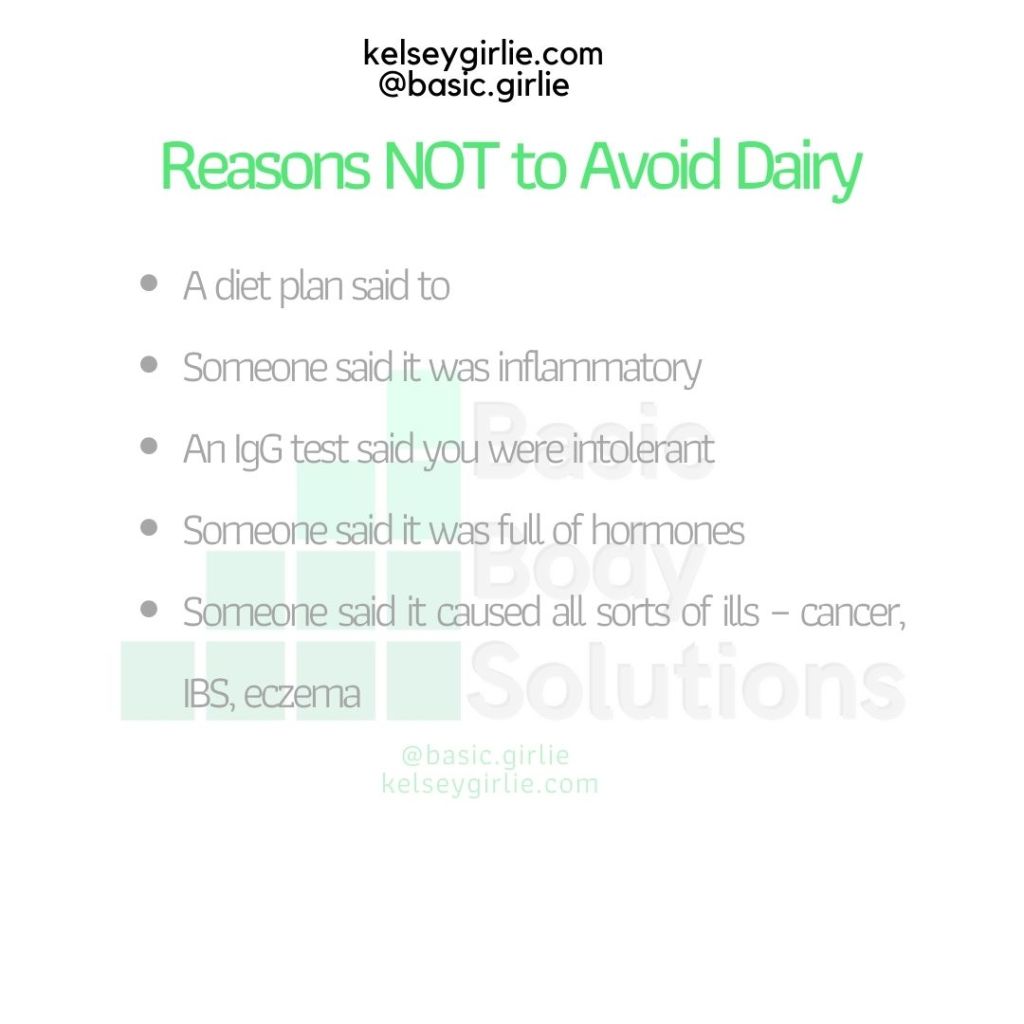
Reasons NOT to avoid
- A diet plan said to
- Someone said it was inflammatory
- An IgG test said you were intolerant
- Someone said it was full of hormones
- Someone said it caused all sorts of ills – cancer, IBS, eczema

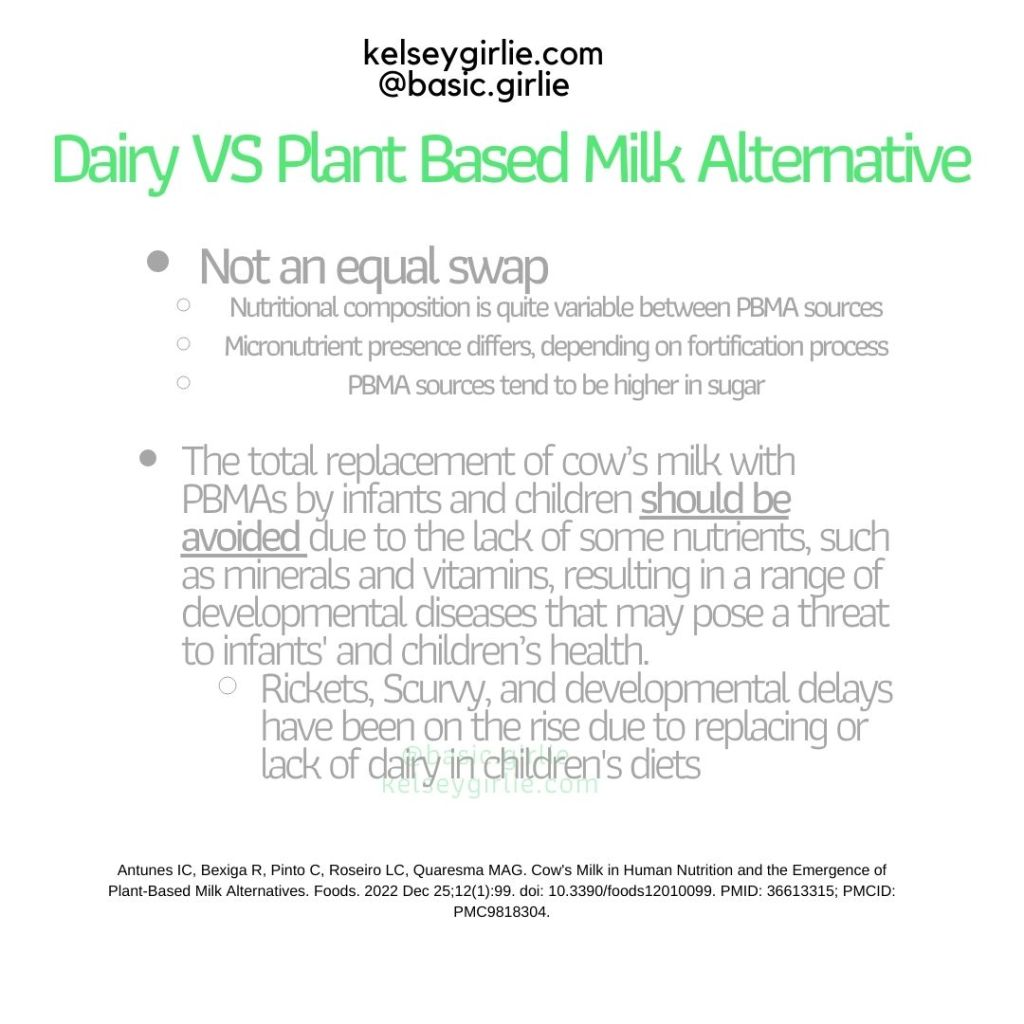
Cow’s Milk in Human Nutrition and the Emergence of Plant-Based Milk Alternatives
- Not an equal swap
- Nutritional composition is quite variable between PBMA sources
- Micronutrient presence differs, depends on fortification process
- PBMA sources tend to be higher in sugar
- The total replacement of cow’s milk with PBMAs by infants and children should be avoided due to the lack of some nutrients, such as minerals and vitamins, resulting in a range of developmental diseases that may pose a threat to infants and children’s health.
- Rickets, Scurvy, and developmental delays have been on the rise due to replacing or lack of dairy in children’s diets


 Basic Body Solutions
Leave a comment